Introducing Navigator
January 7, 2026
Observability has quietly become one of the most critical parts of building reliable software. When something breaks, logs are often the first place engineers go to understand what’s happening.
And yet, for how important logs are, most observability tools feel oddly misaligned with how engineers actually debug.
Across every workplace I’ve been part of, the pattern repeated: powerful tools built for every possible use case, optimized for very few that matter day to day. What should be a simple question – what just went wrong? – turns into a slow search through noise.
About six months ago, I kept coming back to the same question:
What if Linear built an observability tool?
Not “more dashboards” or “more configurations,” but something opinionated around speed and clarity to find out what broke. A tool built for debugging, not for configuration.
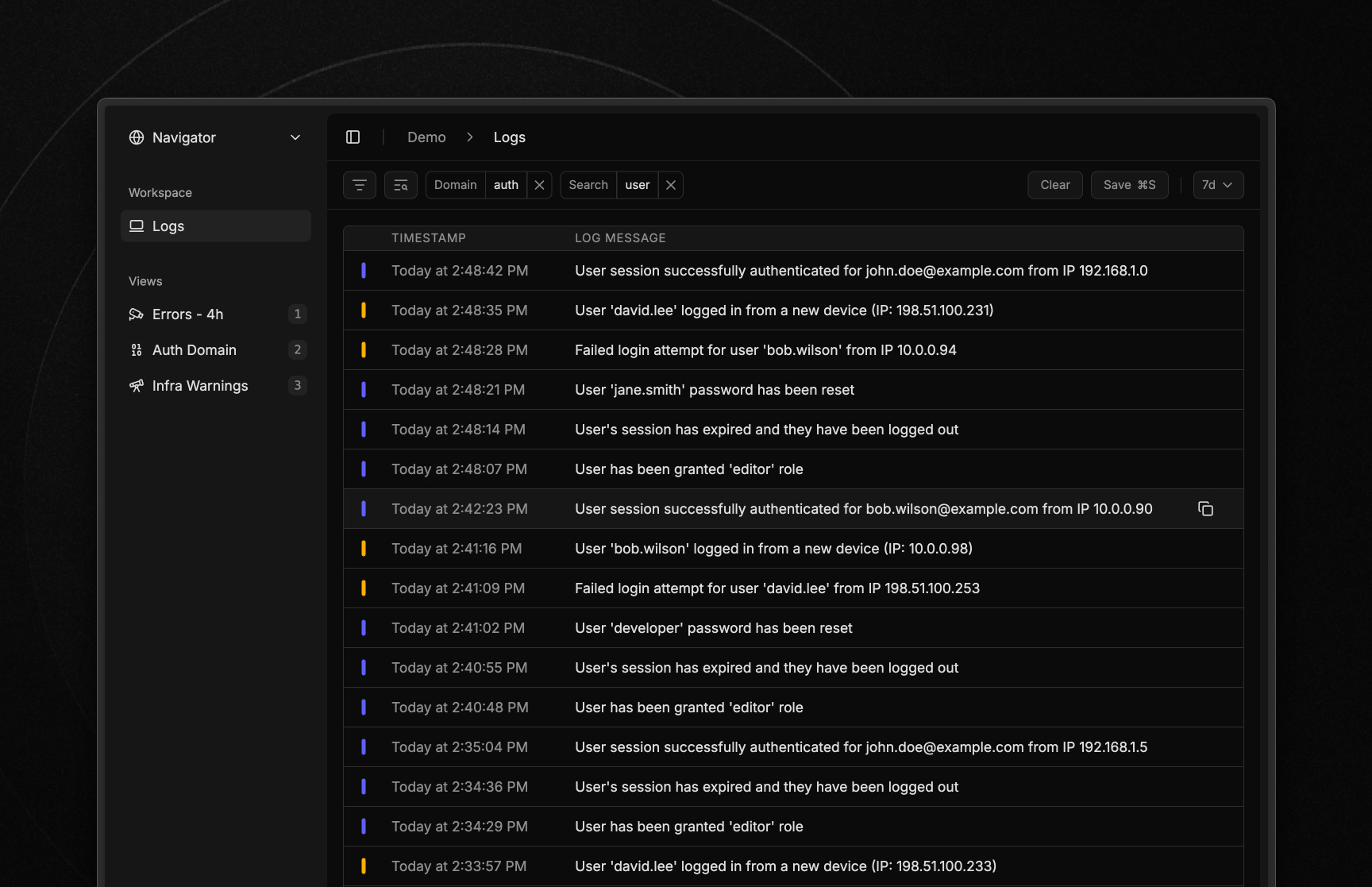
To start, Navigator focuses on what matters most when you’re debugging logs: filtering and search, and get you to the answer “what broke?” as fast a possible. It’s inspired by Linear’s philosophy more than its feature set — fast by default, minimal where possible, and designed to help you move forward instead of slow you down.
This is still very early and Navigator isn’t perfect – in functionality, performance, or polish – but it represents a direction I deeply believe in. A calmer, more intentional approach to observability: helping you debug and ship faster now, and eventually owning more of the debugging so you can focus on shipping.
If this resonates, I’d love for you to try the demo and hear how you debug.